Overview
.
Emergency, tactical, and temporary wireless networks outdoors demand quick and easy deployment. Until now, this usually has come at the cost of performance, especially over larger, multi-hop networks.
The MD4000 third-generation network offers sets up as easily as a first-generation mesh with minimal site engineering, but offers much higher performance. Demanding data applications, high-bandwidth video, and voice traffic are supported, even over many hops.
Performance
Validation
Hastily formed tactical networks:
Meshdynamics products are also being utilized in a variety of hastily formed military and civilian
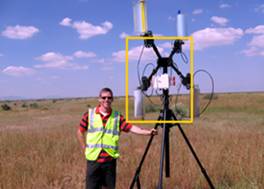
networks. Threat sensors, data, video and even sports-scoring applications are supported over Meshdynamics networks that deploy over broad geographical areas in a few minutes. Network start-up is automatic and immediate when power is applied to the nodes.
No site survey or channel pre-configuration is necessary: the distributed dynamic radio intelligence in each node
manages the complete network set-up process. Meshdynamics units are compact and rugged, making for limited transport cost and weight.
Case Study:
Temporary Mesh Network for Sporting Events.
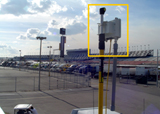
Every week during the season, PGA fans gather at a different outdoor venue for events scheduled by a global professional sporting organization. Besides a glimpse of their favorite players, fans want access to constantly updated scores and standings. The sporting organization positions large scoreboards around the event to provide these statistics, but connecting the displays to the scoring computers required a high performance wireless network that was fast to set up and easy to manage.
Press Release
MD4000 Wi-Fi Wireless Mesh nodes are being deployed each week around the event locations, creating a high-performance, low-latency and low-jitter infrastructure connecting the scoreboards to powerful computers processing scoring data from around the venue.
PGA and others maintains multiple sets of nodes: while one is being set up and used, another is in transit to the next event.
High performance
and fast set-up key to application
When outdoor sporting event organizations began to consider a change from the existing First-Generation wireless mesh supplier, higher performance was the goal. But because the equipment must be installed, tested, and operated for one event, and then removed and transported weekly to the next location on the schedule, fast set-up was mandatory. Although the network was initially intended to support only a single application, the sports organization was pleased to find that the Meshdynamics network installed even more quickly than the First-Generation
Wi-Fi mesh it was tested against and will also provide the higher performance needed to support additional new applications.
This is because
Meshdynamics MD4000 Wireless Mesh nodes use patented and
patent pending third
generation mesh networking technology that allows each node to
choose its best channel and connection path to minimize
interference from other Meshdynamics nodes or external
interference sources.
Visual
Managing spectrum
in a busy environment
The outdoor scoreboards are distributed around the venue so that they may be viewed from many vantage points. Depending on the topology of an individual location, from 15 to 30 wireless mesh nodes are needed to provide complete coverage. In order to avoid the most common interference sources and to provide access to the largest number of unlicensed channels, 802.11a
Wi-Fi at 5.8GHz is used for all connections. Meshdynamics wireless mesh nodes constantly monitor the RF environment, seamlessly moving segments of the network to new channel maps if necessary. The integrity and timeliness of data delivery is critical to fans, broadcasters, and corporate partners, so it's important that the Meshdynamics equipment manages very congested RF Spectrum more reliably than did the sports organization's earlier solutions.
Future
applications on Meshdynamics wireless mesh infrastructure.
The sporting organization plans to move many of its wireless applications away from costly licensed spectrum and onto the Meshdynamics MD4000 wireless mesh networks. Consolidating all of the wireless connectivity on the Meshdynamics wireless mesh will save recurring costs and set-up time while increasing reliability.
Temporary and Tactical Events Related Links
1. Meshdynamics Scores with Outdoor Sports Network Press
Release on impromptu mesh network for sporting events.
2. Border
Security Applications and Solutions: Mobile and static
mesh network deployments along Mexico-Arizona border
3. Military Mesh
Networks Overview document on why Military Mesh
Networks require third generation mesh.
4. High Speed
Mobility Test Video tapes of glitch free video transmission over
multiple hops, traveling at 60+ mph.