|
||
 |
||
         Mesh Network applications often require a string-of-pearls formation where the end-to-end path is non line-of-site (NLOS). Additionally, there may be points along the path where sensor data needs to be collected. One typical such application is perimeter surveillance using remote video cameras mounted at regular intervals along the perimeter being surveyed 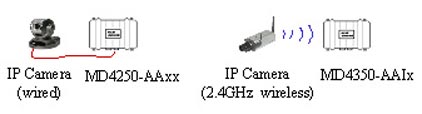
Figure 1: Camera input may be wired in directly into Meshdynamics Ethernet Port IXP1 (right) A perimeter-surveillance deployment does not require the use of 2.4GHz AP radios for client access. The MD4250-AAxx is therefore the most suitable mesh node. IP cameras may be wired into the right-hand Ethernet port on the node, and directional antennas can be used on the uplink and downlink radios for more range between nodes. If a 2.4GHz wireless IP camera is used in the deployment, the MD4350-AAIx will be needed in the line of mesh nodes to provide the AP to which the camera can associate. Otherwise the MD4250 is sufficient for wired camera input. 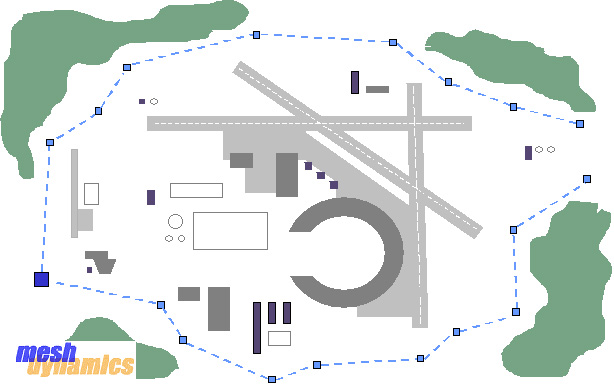
Figure 2: Dual Backhaul Root node converges data traffic from two branches Figure 2 depicts two string-of-pearls mesh chains “snakes”
around the perimeter of an airport. The large blue box is
MD4452 "root"
node with two backhaul downlinks to cover both directions
- the two string of pearls chains. Traffic from both
chains converges via the Ethernet port connected to the root
node. A MD4454 can support up to
4 such forks.
|
||
|
||