The MD4455-AAIA is essentially the
"mobile" version of the three radio
MD4350 - there are two 5GHz 802.11a
backhaul radios, and a 2.4GHz 802.11b/g AP radio. The fourth radio
slot on the MD4455-AAIA motherboard houses a scanning radio. The
scanning radio listens to the RF environment and helps the node make
judicious parent node selections in a high speed mobility
environment.
The MD4355-AAxA is essentially the
"mobile" version of the two radio
MD4250 - there are two 5GHz 802.11a
backhaul radios, slots 0,1, and no radio in slot 2.. The fourth radio
slot on the MD4355-AAxA motherboard houses a scanning radio. The
scanning radio listens to the RF environment and helps the node make
judicious parent node selections in a high speed mobility
environment.
The 4325-IIxI is a 2.4GHz version of the 4355, with three radios: one backhaul
uplink, one backhaul downlink and one 2.4GHz scanner. The downlink radio
doubles as both a backhaul and 2.4Ghz service radio. The 4325 is intended as a
edge edge node. It will interoperate with the 4455: its 2.4GHz uplink will
connect to the most suitable 4455 in its vicinity as a parent, using 2.4GHz
radio on the 4455 as a parent downlink. [Illustration
Meshdynamics
4455-AAIA and 4355-AAxA mobility nodes are in deployment by US military and
its allies. They
validated that the MD4000 provides superior
connectivity even at high speeds. Applications include
video surveillance with cameras mounted on vehicles and
connecting with nodes along the road. Both static and
mobile units have been in operation along the Arizona
Mexico border since 2005. Mobile units have also been
employed in armored vehicle convoys in Iraq.
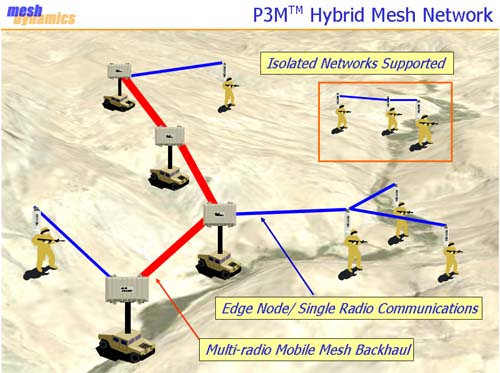
Left: Hybrid Mesh supports both multi-radio
module and single radio edge units.
Right: Video Clip on How P3M Mesh Networks disperse and coalesce
dynamically.
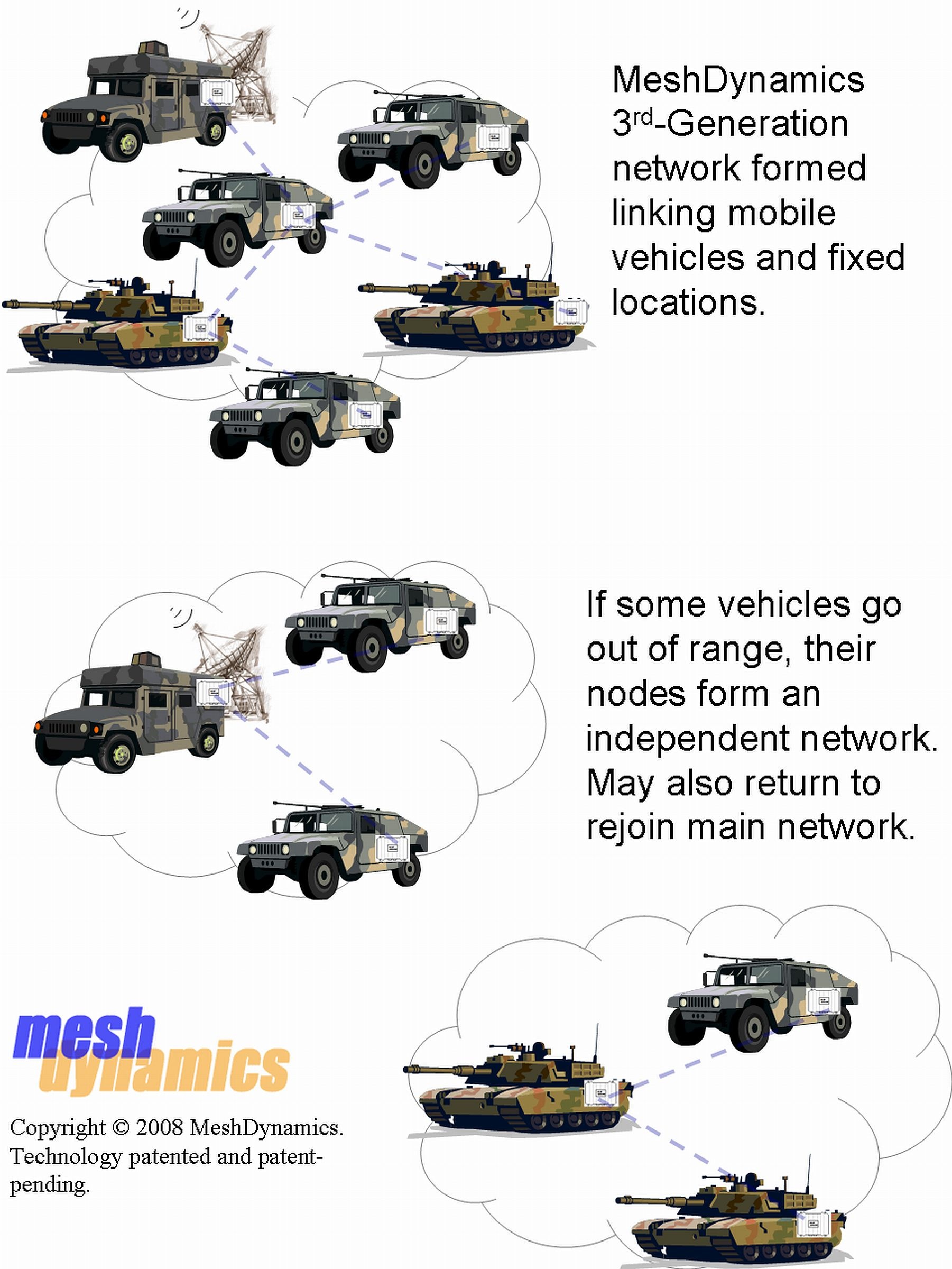
P3M Mobility A cluster of mobile MD4455 will automatically form a
network with each other. If the cluster physically
separates into two smaller clusters, each will then become
its own independent network. If two separate
clusters/networks physically come together, one single
network will form and all nodes + associated clients will
then be able to share data. In a
deployed combat environment in Iraq, MD4355 and MD4455 and vehicle-mounted nodes
demonstrated reliable connectivity between convoy vehicles in
simultaneous motion. Networks split and reformed dynamically
and in real time. Applications supported by Meshdynamics
systems operated flawlessly as vehicles moved through rugged
terrain. P3M
Meshdynamics nodes currently deployed in multiple military programs involving
mesh mobility in US, UK, Canada and
Israel. [Customers]
Also see:
P3M
Press Release and
Illustration
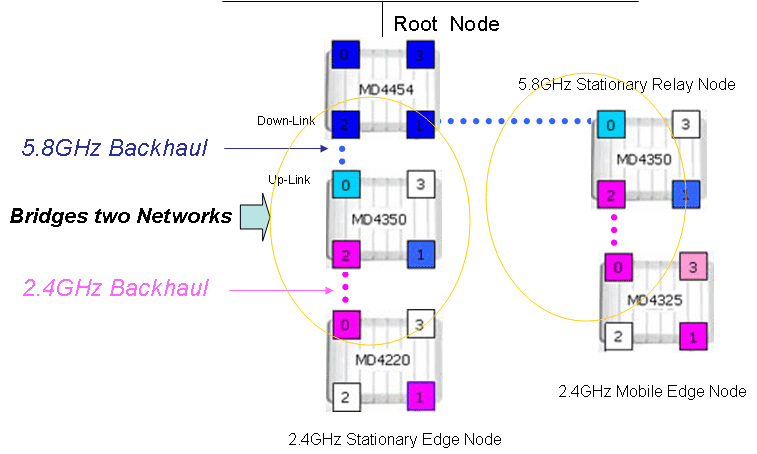
Bridging Networks. Meshdynamics Structured Mesh
networks are inherently tree based. Radios in a
Meshdynamics Mesh networks may operate in one of three
modes: Station, Access Point or (passive Scanner). A 2.4GHz
downlink or parent Access Point provides services to 2.4GHz
Child Stations as part of standard (and scalable) 802.11
infrastructure mode. These 2.4GHz child stations may act as
pseudo roots for 2.4 GHz backhaul trees. [Illustration]
Choice of Backhaul:
When deciding whether to use 2.4GHz based products (4220,4325) RF pollution must
be considered. The clients are 2.4GHz and will interfere with a 2.4GHz node-to-node
(backhaul) link. In addition, 802.11b clients - if attached to the 2.4GHz
backhaul (e.g. 4220, 4325) slows the performance of of the node-to-node link.4220
and 4325 nodes should be limited in servicing few child nodes. On the positive
side, 2.4 GHZ has about twice the range at 5GHz, so 4325, 4220 are preferable
where range supersedes backhaul capacity.