The capacity and “backhaul structure” of a mesh benefit from a root or relay nodes having multiple downlink radios. MD4452-AAIA employs
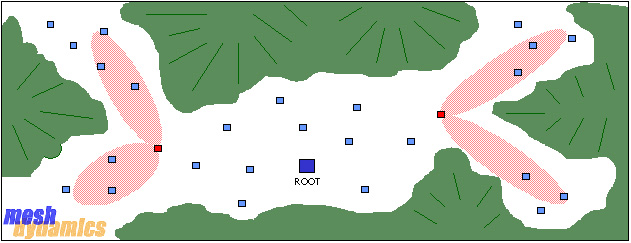
two backhaul downlinks to enable branching of the backhaul. It also
has one uplink and one service radio. In the illustration below, the
use of multiple downlinks supports two separate mesh branches. If a
wired Ethernet link is attached to it, then the MD4452 configures itself as
a root node and merges data from the two branches.
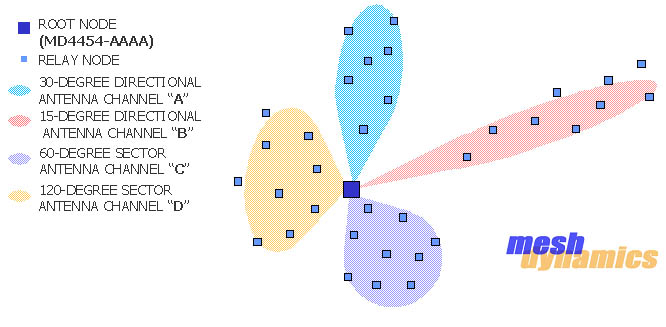
MD4454-AAAA has all four radios as downlinks. This dictates that the node can
only be used as a root node - there are no uplinks so it cannot be used
as a relay node also. The primary use of the MD4454 is to provide four separate branches of
the mesh tree with each branch using a different type of antenna to support
specific range/coverage (see below). Since each radio uses a separate 802.11a channel, the full TCP/IP throughput of each
radio results in a total of 4X of each sub tree feeding into the root.