What
is the typical range (node to node distance)? What
is the typical range (node to node distance)? |
Range is
dependant on antenna gain, radio transmit power, radio
receive sensitivity, obstructions and RF interference in
the environment. It is also dependant on the data
rate sought - the range is significantly more at 6 Mbps
than 20 Mbps data rates. Range also depends on whether a
5GHz backhaul or 2.4GHz backhaul is used. At a throughput
of 20-22 Mbps TCP/IP, with 5GHz radios and 8 dB antennas
400-500 m range is commonplace. 14 miles has been achieved
by DHS
See Also :
Backhaul Range
Access
Point Range
Antenna Alignment
|
| |
|
What
is the field tested throughput of Meshdynamics MD4000 mesh nodes?
|
MD4000
products use a 5GHz backhaul and 2.4GHz radios for
client service. Tests conducted by US government labs
indicate 54 Mbps raw and approx
22 Mbps
TCP/IP for the 80211abg radios. There was no appreciable degradation due to
Meshdynamics
Third-Generation technology that allows bandwidth to be conserved over
multiple relay or "hops". The OpenWRT unit with 80211ac
MIMO radios
clocks in at 200+ Mbps in preliminary field tests by the
US Government.
Note: OEM Licensees have run
on non-OpenWRT boards and 802.11ac radios.
Sharp-QX-C300-Series-Press-Releases. |
| |
|
What
is the maximum data traffic distribution supported
emanating from a one wired Ethernet link? |
Approx 80
Mbps TCP/IP in non turbo mode with the MD4454 with 80211
abg radios
MD4454
was measured. This is four radios
configured as 802.11a downlinks - four branches from the
Ethernet link.
Note:
OEM Licensees have ported the code to run
802.11ac and 802.11n radios.
Sharp-QX-C300-Series-Press-Releases |
| |
|
What
is the typical range of the AP radio (node to client distance)? |
| With an 8dBi
omni-directional antenna on the AP radio, clients can
associate (on 802.11b/g) from 300 meters
provided the client is in line of site with the mesh
node. If the client device in not in line
of site, the distance decreases to 100-150 meters. Range
depends on connectivity modes. Clients on 802.11b
can achieve twice the range of 802.11g mode. More
|
| |
|
What is the power consumption for the
Meshdynamics MD4000 mesh nodes? |
MD4000 mesh node
configurations support from two to four active radios in
the same enclosure .The processor consumes around 8 W.
Each active radio uses approx 2 W to produce 400 mw
output power on the 802.11 abg radios. Power consumption varies
from 12 W (two radios) to 16 W (four active
radios).
Note: the components on the MD4000 board run on 3.3V
(nominal), so there is a DC-DC converter on the board. The
input voltage range supported is 9-48 volts. If the RJ45
Ethernet port is used to provide Power over Ethernet
(POE), then the maximum allowable current over the RJ45
leads is 1A. The
recommended POE is rated at
24V 2A.
A variant of the MD4000 board may also be powered
directly from low voltage portable battery packs. [More] |
| |
|
What are the
dimensions and weight of the MD4000 mesh nodes? |
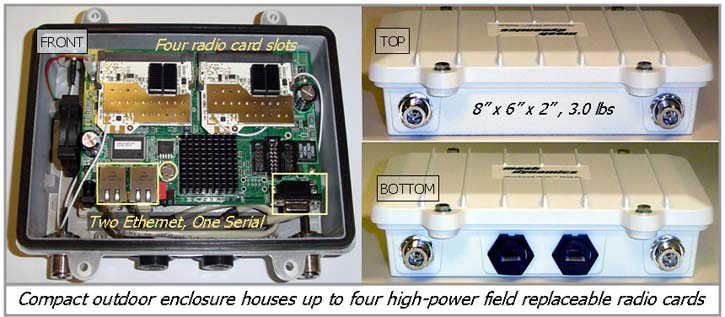
| The
weatherproof die
cast aluminum enclosure is 8" long by 6" width
by 2" deep. The unit weighs 3 lbs. [Images] |
| |
|
What
is the default Meshdynamics MD4000 configuration ? |
| The MD4350-AAIx is our
most commonly requested configuration. This is a three-radio mesh node that
uses two of its radios for the 5GHz, 802.11a
multi-channel backhaul. The third radio is a
2.4GHz AP. [MD4000
Numbering Scheme] |
| |
|
Does
the Meshdynamics MD4000 configuration support multiple access point
radios (AP)? |
| Yes. The MD4458-AAII has two access point (AP) radios. The
MD4458-AIII has three AP radios and no downlink. [More] |
| |
|
Does
Meshdynamics offer a backhaul-only configuration for perimeter
video surveillance? |
| Yes. Where client
access is not required, The
MD4250-AAxx two-radio (5Ghz uplink and downlink radios)
is suggested. As with all MD4000 mesh nodes, wired clients such as IP cameras
may plug directly into one of two Ethernet port. [More] |
| |
|
What does Meshdynamics recommend for antenna selection
and alignment techniques?
|
Antenna selection and alignment is critical to
establishing a reliable RF link. Also Meshdynamics 5GHz
radios need antennas that support a range from 5.25GHz to
5.85GHz.
Superpass
antennas are recommended.
The antenna type (omni or sectored) is driven by range and throughput requirements . Some general
suggestions are provided
here. Please
feel free to contact
Technical Support
to explore which model
and antenna is best for your application.
|
|
|
|
How are unusually-shaped meshes handled by the MD4000
mesh node?
|
|
Relay nodes equipped with two downlink radios allow a
"shaping" of the mesh by having the ability to
shoot downlink signals in separate directions. This
is especially helpful in geographical bottlenecks. [More]
|
| |
|
Go To Page
1
2
|
| |